
تشخيص الأعطال
كيف تفحص محرك الغسالة بالمالتيميتر: دليل خطوة بخطوة
ثلاث قياسات بالمالتيميتر تفصل بين محرك سليم ومحرك تالف. دليل خطوة بخطوة يوضح ما تقيسه وكيف تقرأ النتيجة.
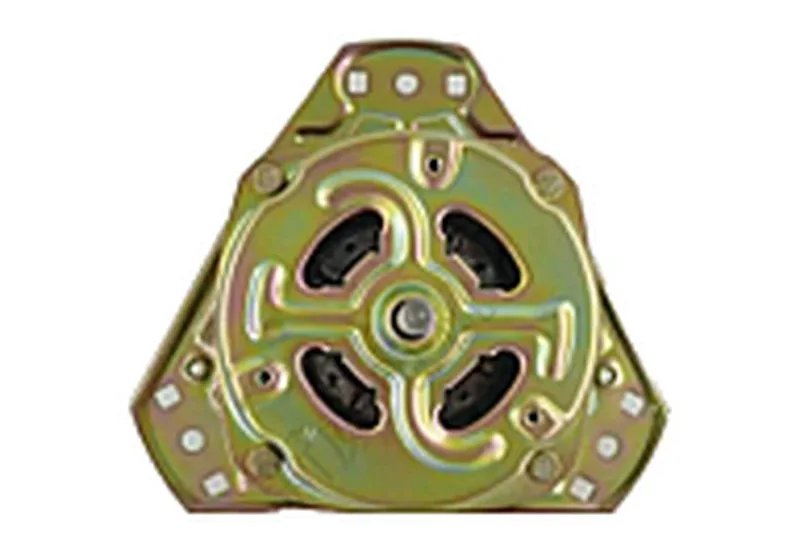
What You Need Before Starting
A digital multimeter with resistance (ohms), continuity, and ideally capacitance modes covers this entire procedure. No clamp meter or insulation tester is strictly required for a go/no-go decision, although a megohmmeter gives a more definitive ground insulation verdict in humid environments.
Safety rules are non-negotiable: unplug the washer from the mains, discharge the capacitor through a resistor before touching its terminals, and disconnect the motor's leads so you are measuring the motor alone, not the motor in-circuit with the timer and wiring.
Step 1: Identify the Terminals
A typical single-phase washer motor has a main winding and an auxiliary winding sharing a common terminal. On most 45W-200W models the terminal block is marked or color-coded; if not, you can identify windings by measuring between each pair of terminals and noting the three readings.
The main winding reads lowest resistance, the auxiliary winding reads highest, and the pair across both windings reads their sum. Write the three values down; comparing them against each other is how you detect the fault, even without a factory datasheet.
Step 2: Measure the Winding Resistance
With the motor isolated, measure resistance across each winding. For 220-240V motors in the 45W-200W class, expect finite readings typically in the tens of ohms. Interpret the results this way:
- A reading near zero ohms: shorted turns or a shorted winding. The motor must be replaced
- An infinite (open) reading: burnt-through or broken winding. Replace the motor
- Both windings read plausible values but differ wildly from each other with no documentation: suspect the lower one is partially shorted, especially if the motor also ran hot
- Readings are finite and plausible: the winding side is healthy, move on to ground insulation
One caution: winding resistance varies with temperature and between designs, so absolute numbers matter less than the pattern. A winding that is open or near-zero is unambiguous. Values that merely look unusual deserve a second measurement after the motor has cooled.
Step 3: Test Insulation to Ground
Set the meter to its highest resistance range and measure between each winding terminal and the motor frame (bare metal, paint scraped away if needed). A healthy motor reads in the megaohm range; anything below about 1-2 megaohms indicates degrading insulation, and any reading near zero is a ground fault.
A ground fault means the winding is contacting the frame, which is a genuine shock hazard, not just a reliability problem. Motors that failed the ground test are removed from service immediately in every professional workshop, and this is exactly the failure mode that the factory dielectric test, 1500V for 1 second between winding and frame on every XinWei motor, is designed to catch before shipping.
Step 4: Test the Capacitor
If both windings and insulation check out but the motor still hums without turning, the capacitor is the prime suspect. Discharge it first, then measure with the meter's capacitance mode across the terminals.
A healthy capacitor reads within roughly ±5-10% of its rated value (commonly 8-15 µF, 450V AC in this motor class). Significantly below range means weak starting torque, and a reading near zero means the capacitor is dead. When in doubt, the swap test with a known-good unit settles it in seconds.
Step 5: The Mechanical Check No Meter Can Do
Electrical tests prove the windings, but a motor can pass every electrical test and still be unusable if the bearings are seized. With power disconnected, rotate the shaft by hand: it should turn smoothly with slight, even resistance and no grinding or knocking.
Also inspect the shaft surface where the pulley mounts. A scored or rusty shaft will destroy a new belt quickly. This two-minute mechanical inspection, combined with the three meter tests, gives a complete verdict on any washer motor in under fifteen minutes.
Reading the Verdict: Repair or Replace
Summarize the decision rule used across the service industry: open or shorted windings, a ground fault, or seized bearings mean replacement; a failed capacitor, loose terminals, or external wiring faults mean repair. Everything in between, marginal insulation readings in a humid climate, borderline capacitance, is a judgment call best made on the machine's remaining value.
For distributors and repair chains that need replacement stock, matching the original motor is the critical step: power rating (45W-200W across our XW-YYG and XW-XD series), shaft diameter and length, mounting holes, and the matched capacitor rating. Send a photo of the nameplate or the old motor itself, and our export team will identify the matching model and reply with specifications within one business day.
Frequently Asked Questions
What resistance should a washing machine motor winding read?
For 220-240V motors in the 45W-200W class, expect finite readings in the tens of ohms, with the main winding lower than the auxiliary winding. The critical verdicts are near zero ohms (shorted turns) or infinite resistance (open winding), both of which mean the motor must be replaced.
How do I know if a washer motor is shorted to ground?
Measure resistance between each winding terminal and the bare motor frame on the highest ohms range. A healthy motor reads in the megaohms; below roughly 1-2 megaohms the insulation is degrading, and any near-zero reading is a ground fault. Motors with ground faults must be taken out of service immediately.
The motor passes all electrical tests but still won't turn. What now?
Check the mechanical side: rotate the shaft by hand for seized bearings, and verify the capacitor, since a healthy winding with a dead capacitor produces exactly the hum-without-rotation symptom. Also confirm the drive belt and transmission are not locked.
Need a Washing Machine Motor Supplier?
Send us your model, quantity, and country. Get a factory quotation within 24 hours.